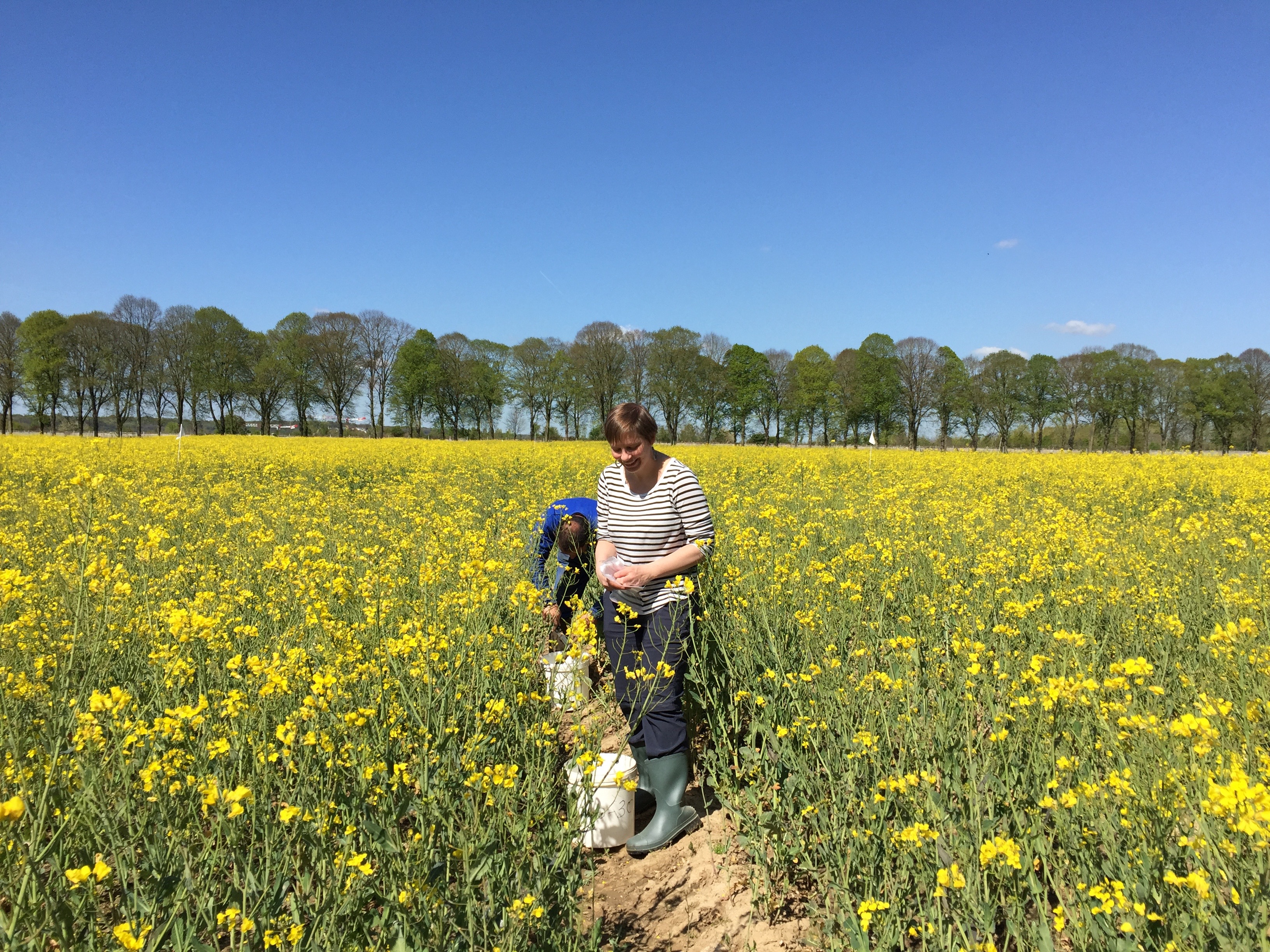
Research focus
The Hazard lab is dedicated to exploring the diversity, distribution and interactions of soil microorganisms and viruses in natural and anthropized ecosystems, the factors influencing their communities and activities, and their contribution to biogeochemical cycling. Research includes a focus on specific microbial functional groups such as mycorrhizal fungi, and nitrogen and methane cycling microbes and their viruses. We use field and lab based experiments and measure functional process rates and changes in microbial and viral communities using meta-omic approaches. We also aim to develop strategies for the mitigation of environmental nitrogen pollution and controlling microbial-mediated greenhouse gas emissions.
Christina Hazard
Group Leader / CNRS Researcher / HDR
christina.hazard@univ-lyon1.fr
Service & Leadership
Associate Editor of Microbiome
Senor Editor of Environmental Microbiome
Member of the Applied Microbiology International Healthy Land Advisory Committee
Research Panel Member of the High Council for Evaluation of Research and Higher Education (Hcéres), France
Publications
Bachtsevani E, Kolovou M, Papadopoulou ES, Karpouzas DG, Nicol GW, Hazard C. 2025. Single species in vitro assays with nitrifying bacteria and archaea for assessing the toxicity of pesticides on soil microorganisms. Environmental Science and Technology, 59: 20941-20953. doi.org/10.1021/acs.est.5c02995
Hazard C, Anantharaman K, Hillary LS, Neri U, Roux S, Trubl G, Williamson K, Pett-Ridge J, Nicol GW, Emerson JB. 2025. Beneath the surface: Unsolved questions in soil virus ecology. Soil Biology and Biochemistry, 205: 109780. doi.org/10.1016/j.soilbio.2025.109780
Guigard L et al., 2025. The connections of climate change with microbial ecology and their consequences for ecosystem, human, and plant health. Journal of Applied Microbiology, 136: Ixaf168. doi.org/10.1093/jambio/lxaf168
Yao B-M, Nicol GW, Shi Y, Hazard C, Zhang Z-M et al., 2025. Vegetation dominantly shapes the elevation patterns of archaeal and protistan communities and their ecological functions in the Hengduan Mountains, Tibetan Plateau. Functional Ecology, 00: 1-15. doi.org/10.1111/1365-2435.70114
Cai Y-J, Zhang H-Y, Hu X-R, Yang Y-C, Hazard C et al., 2025. Millimeter-scale niche differentiation of N-cycling microorganisms across the soil-water interface has implications for N2O emissions from wetlands. The ISME Journal, wraf062. doi.org/10.1093/ismejo/wraf062
Toucedo-Suárez et al., 2025. Meeting report: International soil virus conference 2024. Virus Research, 354: 199544. doi.org/10.1016/j.virusres.2025.199544
Sieradzki ET, Allen GM, Kimbrel JA, Nicol GW, Hazard C, Nuccio EE, Blazewicz SJ, Pett-Ridge J, Trubl G. 2025. Phosphate amendment drives bloom of RNA viruses after soil wet-up. Soil Biology and Biochemistry, 205: 109791. doi.org/10.1016/j.soilbio.2025.109791
Lee S, Nicol GW, Hazard C. 2025. Soil pH influences the composition of bacteriophage communities infecting individual hosts. Soil Biology and Biochemistry, 210: 109948. doi.org/10.1016/j.soilbio.2025.109948
Lee S, Hazard C, Nicol GW. 2024. Activity of novel virus families infecting soil nitrifiers is concomitant with host niche differentiation. The ISME Journal, 18: wrae205. doi.org/10.1093/ismejo/wrae205
Wang X, Wu M, Wei Z, Hazard C, Nicol GW, Zhao H, Liu B, Zhang J, Shan J, Yan X. 2024. Investigating drivers of free-living diazotroph activity in paddy soils across China. Soil Biology and Biochemistry, 199: 109601. doi.org/10.1016/j.soilbio.2024.109601
Hink L, Bachtsevani E, Meng Y, Sedlacek CJ, Lee S, Daims H, Wagner M, Gubry-Rangin C, Boer W, Hazard C, Prosser JI, Nicol GW. 2024. Acidotolerant soil nitrite oxidiser ‘Candidatus Nitrobacter laanbroekii’ NHB1 alleviates constraints on growth of acidophilic soil ammonia oxidisers. bioRxiv doi.org/10.1101/2024.07.06.601931
Lehtovirta-Morley LE, Ge C, Ross J, Yao H, Hazard C, Gubry-Rangin C, Prosser JI, Nicol GW. 2024. Nitrosotalea devaniterrae gen. nov., sp. nov., and Nitrosotalea sinensis sp. nov., two acidophilic ammonia oxidising archaea isolated from acidic soil, and proposal of the new order Nitrosotaleales ord. nov. within the class Nitrososphaeria of the phylum Nitrososphaerota. International Journal of Systemic and Evolutionary Microbiology, 74: 006387. doi.org/10.1099/ijsem.0.006387
Graham EB, Camargp AP, Wu R, Neches RY, Nolan M, Paez-Espino D, Kyrpides NC, Jansson JK, McDermott JE, Hofmockel KS, the Soil Virosphere Consortium. 2024. A global atlas of soil viruses reveals unexplored biodiversity and potential biogeochemical impacts. Nature Microbiology, 9: 1873-1883. doi.org/10.1038/s41564-024-01686-x
Lee S, Sieradzki ET, Nicol GW, Hazard C. 2023. Propagation of viral genomes by replicating ammonia-oxidising archaea during soil nitrification. The ISME Journal, 17: 309-314. doi.org/10.1038/s41396-022-01341-5
Fremin BJ, Bhatt AS, Kyrpides NC, Global Phage Small Open Reading Frame (GP-SmORF) Consortium. 2022. Revealing thousands of small, novel genes in global phage genomes. Cell Reports, 12: 110984. doi.org/10.1016/j.celrep.2022.110984
Watmough SA, Gilbert-Parkes S, Basiliko N, Lamit LJ, Lilleskov EA, Andersen R. et al. Hazard C, et al., 2022. Variation in carbon and nitrogen concentrations among peatland categories at the global scale. PLoS ONE, 23: e0275149. doi.org/10.1371/journal.pone.0275149
Watmough SA, Gilbert-Parkes S, Basiliko N, Lamit LJ, Lilleskov EA, Andersen R. et al. Hazard C, et al., 2022. Latitude, elevation, and mean annual temperature predict peat organic matter chemistry at a global scale. Global Biogeochemical Cycles, 36: e2021GB007057. doi.org/10.1029/2021GB007057
Lee S, Sorensen JW, Walker RL, Emerson JB, Nicol GW, Hazard C. 2022. Soil pH influences the structure of virus communities at local and global scales. Soil Biology and Biochemistry, 166: 108569. doi.org/10.1016/j.soilbio.2022.108569
Lee S, Sieradzki ET, Nicolas AM, Walker RL, Firestone MK, Hazard C, Nicol GW. 2021. Methane-derived carbon flows into host-virus networks at different trophic levels in soil. Proceedings of the National Academy of Sciences of the USA, 118: e2105124118. doi.org/10.1073/pnas.2105124118
Finn DR, Lee S, Lanzén A, Bertrand M, Nicol GW, Hazard C. 2021. Cropping systems impact changes in soil fungal, but not prokaryote, alpha-diversity and community composition stability over a growing season in a long-term field trial. FEMS Microbiology Ecology, 97: fiab136. doi.org/10.1093/femsec/fiab136
Hazard C, Prosser JI, Nicol GW. 2021. Use and abuse of potential rates in soil microbiology. Soil Biology and Biochemistry,157: 108242. doi.org/10.1016/j.soilbio.2021.108242
Finn DR, Bergk-Pinto B, Hazard C, Nicol GW, Tebbe C, Vogel TM. 2021. Functional trait relationships demonstrate life strategies in terrestrial prokaryotes. FEMS Microbiology Ecology, 97: fiab068. doi.org/10.1093/femsec/fiab068 (FEMS best article award)
Hung Y, Jing J, Yan M, Hazard C, Chen Y, Guo C, Xiao X, Lin J. 2021. Contribution of pathogenic fungi to N2O emissions increases temporally in intensively managed strawberry cropping soil. Applied Microbiology and Biotechnology, 105: 2043-2056. doi.org/10.1007/s00253-021-11163-8
Hazard C and Johnson D. 2018. Does genotypic and species diversity of mycorrhizal plants and fungi matter for ecosystem functioning? New Phytologist, 220: 1122-1128. doi.org/10.1111/nph.15010
Hazard C, Kruitbos L, Davidson H, Taylor AFS, Johnson D. 2017. Strain identity of the ectomycorrhizal fungus Laccaria bicolor is more important than richness in regulating plant and fungal performance under nutrient rich conditions. Frontiers in Microbiology, 8: 1874. doi.org/10.3389/fmicb.2017.01874
Hazard C, Kruitbos L, Davidson H, Taylor AFS, Johnson D. 2017. Contrasting effects of intra- and interspecific identity and richness of ectomycorrhizal fungi on host plants, nutrient retention and multifunctionality. New Phytologist, 213: 852-863. doi.org/10.1111/nph.14184
Hazard C, Boots B, Keith A, Mitchell DT, Schmidt O, Doohan FM, Bending GD. 2014. Temporal variation outweighs effects of biosolids application in arbuscular mycorrhizal fungi communities on plants grown in pasture and arable soils. Applied Soil Ecology, 82: 52-60. doi.org/10.1016/j.apsoil.2014.05.007
Grubisha LC, Dowie NJ, Miller SL, Hazard C, Horton TR, Trowbridge SM. 2014. Rhizopogon kretzerae sp. Nov.: the rare fungal symbiont in the tripartite system with Pterospora andromedea and Pinus strobus. Botany, 92: 527-534. doi.org/10.1139/cjb-2013-0309
Hazard C, Gosling P, Mitchell DT, Doohan FM, Bending GD. 2014. Diversity of fungi associated with hair roots of ericaceous plants is affected by land use. FEMS Microbiology Ecology, 87: 586-600. doi.org/10.1111/1574-6941.12247
Hazard C, Gosling P, Van der Gast C, Mitchell DT, Doohan FM, Bending GD. 2013. The role of local environment and geographical distance in determining community composition of arbuscular mycorrhizal fungi at the landscape scale. The ISME Journal, 7: 498-508. doi.org/10.1038/ismej.2012.127
Keith A, Boots B, Hazard C, Niechoj R, Arroyo J, Bolger T, Breen J, Clipson N, Doohan FM, Griffin CT, Schmidt O. 2012. Cross-taxa congruence, indicators and environmental drivers in soils under agriculture and extensive land management. European Journal of Soil Biology, 49: 55-62. doi.org/10.1016/j.ejsobi.2011.08.002
Hazard C, Lilleskov EA, Horton TR. 2011. Is rarity of pinedrops (Pterospora andromedea) in eastern North America linked to rarity of its unique fungal symbiont? Mycorrhiza, 22: 393-402. doi.org/10.1007/s00572-011-0414-y
Kelsall N, Hazard C, Leopold DJ. 2004. Influence of climatic factors on demographic changes in New York populations of the federal-listed Phyllitis scolopendium (L.) Newm. var. americana. Journal of the Torrey Botanical Society, 13: 161-168. doi.org/10.2307/4126917
 Hazard Lab & Nicol Lab